
Best Dog-Friendly National Parks in the US
A look at 10 US national parks' official pet policies — where dogs can and can't go, leash rules and BARK Ranger programs — pulled directly from each park's own NPS.gov Pets page.
How this guide was built: Guidevio compiled it from each national park's own official NPS.gov Pets page (or, where one didn't exist, its Basic Information and Things To Do pages). We did not visit these parks as part of building it, and nothing here is a review, a ranking based on personal experience, or a sponsored placement. Pet rules can change, including seasonally, so always check the park's own Pets page before a trip. Links go to official NPS.gov pages and earn no commission today; if that changes, it will be disclosed here.
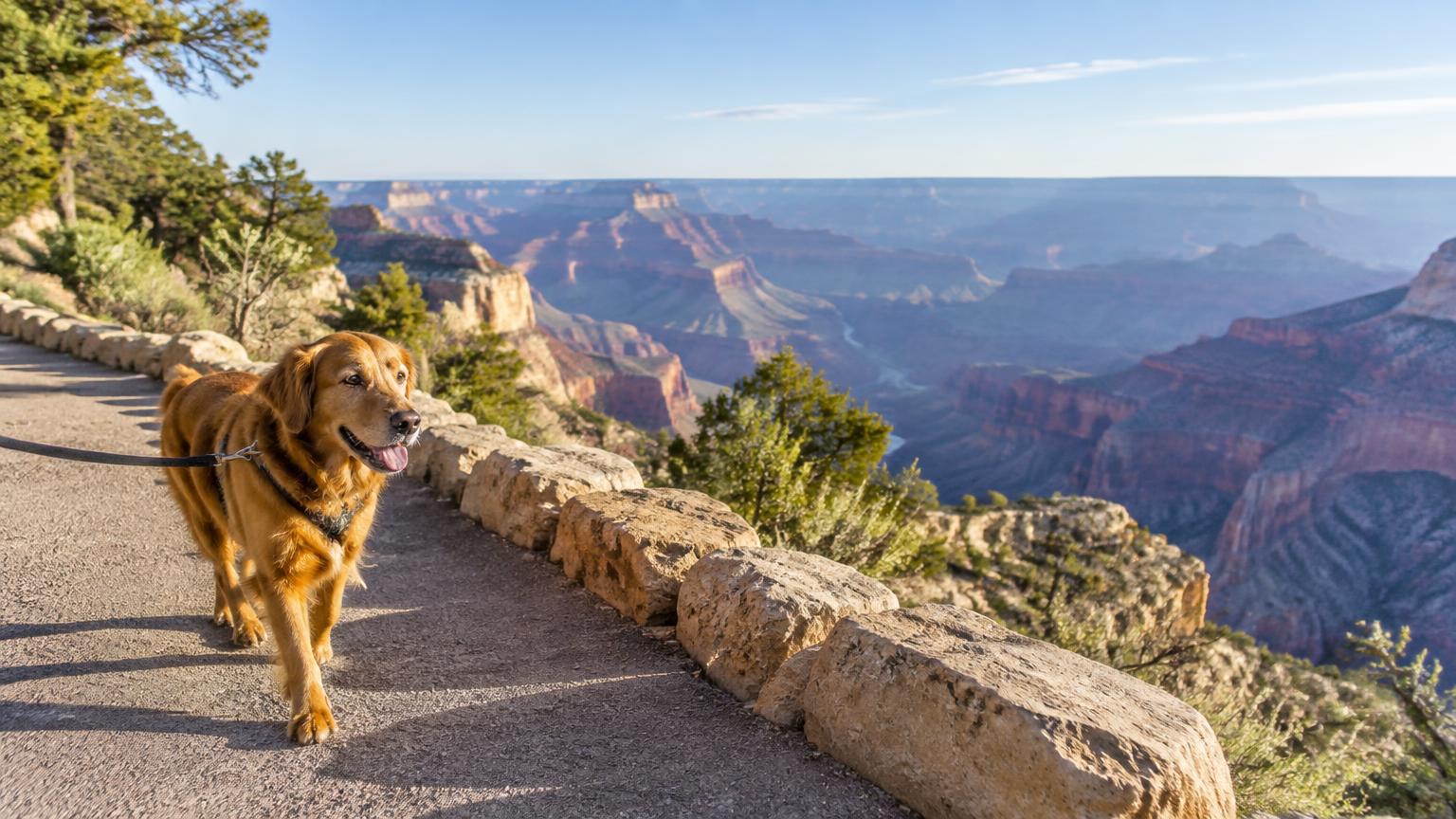
Most national parks restrict dogs to roads, campgrounds and picnic areas, with trails generally off-limits to protect wildlife and visitors. But a smaller group of parks explicitly allow leashed dogs on many or most of their trails, and several run their own version of the National Park Service's B.A.R.K. Ranger program. This guide covers ten parks with the clearest published pet policies, ranging from parks that allow dogs on the vast majority of trails to one included specifically as a caution because of how restrictive it is.
The factors that matter most for a trip with a dog are where exactly dogs are and are not allowed within a given park, the leash requirements that apply everywhere, whether the park runs a BARK Ranger or similar pledge program, and any boarding or kennel option for the parts of a park dogs can't access. All of this varies significantly by park and is set out on each park's own NPS.gov Pets page, which is also where rules should be reconfirmed before a visit since they can change seasonally.
What was checked for each park: the official NPS.gov 'Pets' page (or, where a park does not have a standalone Pets page, its Basic Information and Things To Do pages), the specific trail and area restrictions stated there, the leash-length requirement, whether a BARK Ranger or similar pledge program is described, and any linked boarding or kennel information. Nothing below is based on a personal visit; it reflects only what each park publishes on its own site.
Who this guide is for
- Dog owners planning a national park road trip who want to know before they go
- Hikers deciding which park to visit based on trail access for dogs
- Owners who need a boarding or kennel option for a below-rim or cave portion of a trip
- First-time visitors comparing leash rules and BARK Ranger programs across parks
- Travelers weighing a very restrictive park (like Great Smoky Mountains) against more permissive alternatives
- Anyone building a multi-park itinerary who wants official trail-access facts in one place
How we chose
- Selected parks with the clearest, most detailed official Pets pages on NPS.gov
- Prioritized parks that explicitly allow leashed dogs on most trails, not just roads and campgrounds
- Included one restrictive park (Great Smoky Mountains) as a contrast entry, since it is the most-visited US national park
- Pulled leash rules, trail restrictions, BARK Ranger details and waste rules directly from each park's own Pets page
- Where a detail was not published on the pages checked, that is stated rather than assumed
- This is desk research only: no parks were visited in person as part of building this guide
Top 10 at a glance
Specifications as published by the manufacturer or the listing we consulted. Scroll sideways on a small screen.
| Pick | Best for | Trail access | Leash rule | BARK Ranger program | Notable restriction | Price | Official site |
|---|---|---|---|---|---|---|---|
| 1. Acadia National Park | Owners wanting extensive leashed trail and carriage-road access along the coast of Maine | Allowed on most of 100+ miles of trails and carriage roads, with stated exceptions | No longer than 6 feet (federal law) | Yes — Acadia Bark Ranger, collar tag at Eastern National Bookstore | Some trails closed per 'Where to Go (and Where Not To)'; avoid ladder/rung trails | See current fees at nps.gov | Visit |
| 2. Shenandoah National Park | Hikers wanting one of the most extensive leashed-trail networks of any national park | One of the few national parks that allows pets on trails, per NPS | Physical leash no longer than 6 feet at all times | Linked to general NPS B.A.R.K. program | A specific list of closed trails exists; not allowed on Ranger Programs | See current fees at nps.gov | Visit |
| 3. Cuyahoga Valley National Park | Urban-adjacent park visitors wanting long, flat, dog-friendly towpath walks | Welcome on 100+ miles of trails and the Towpath Trail, with exceptions | Six feet or shorter at all times | General NPS B.A.R.K. link; no park-specific badge detailed | No pets in buildings, on the Scenic Railroad, East Rim bike trails, or Kendall Hills during sledding | See current fees at nps.gov | Visit |
| 4. Grand Canyon National Park — South Rim Trail | Visitors wanting rim-view walks with a dog while boarding the dog for any below-the-rim hiking | Leashed pets on South Rim trails above the rim only | Up to 6 feet at all times | Not listed | No pets below the canyon rim or on park shuttle buses; boarding available at Grand Canyon Kennel | See current fees at nps.gov | Visit |
| 5. Petrified Forest National Park | Owners wanting a dedicated off-leash dog park plus full trail and backcountry access for leashed dogs | Any paved road or trail, plus all designated wilderness area | Six feet or less | Yes — sign up at entrance booths or visitor centers | Only service animals allowed in park buildings | See current fees at nps.gov | Visit |
| 6. Congaree National Park | Owners wanting full trail and boardwalk access through an old-growth floodplain forest | All trails, including the boardwalk, plus campgrounds | Six feet long maximum; pets under control, not left unattended | Yes — park mascot Nova | Caution advised on the confined elevated boardwalk; snake and tick caution | See current fees at nps.gov | Visit |
| 7. Mammoth Cave National Park | Visitors planning to combine a cave tour (dog boarded) with surface-trail hiking with their dog | All surface trails; not permitted in caves | Up to 6 feet at all times | Referenced — mascot Stella | No pets in caves, visitor center, or on cave tours (service animals only) | See current fees at nps.gov | Visit |
| 8. Indiana Dunes National Park | Owners wanting Lake Michigan beach access with a dog plus an active ranger-led BARK program | Beaches year-round (West Beach exception in summer); most trails except Pinhook Bog | No longer than 6 feet (2 meters), including while swimming | Yes — INDU B.A.R.K. Ranger, mascot Max | West Beach lifeguard-season exception; Pinhook Bog Trail and equestrian Glenwood Dunes section off-limits | See current fees at nps.gov | Visit |
| 9. Badlands National Park | Road-trippers content with roadside overlooks, campground stays, and back-road walks rather than trail hiking | Roads, developed areas and parking lots only; not trails or Wilderness Area | No more than six feet at all times | Not listed | No pets on trails, in buildings, in the Wilderness Area, or near prairie dog colonies | See current fees at nps.gov | Visit |
| 10. Great Smoky Mountains National Park | Owners only wanting roadside, picnic-area, campground, or one of two short specific-trail walks, not general hiking | Only two trails: Gatlinburg Trail and Oconaluftee River Trail | No longer than 6 feet at all times | Not listed | Most trails and many areas off-limits; park recommends considering leaving pets at home | See current fees at nps.gov | Visit |
The ten picks in detail
Acadia National Park
National Park Service
We only show official or licensed product photography. None is on file for this one yet — see the maker's page for photos.
Open product pageAcadia National Park
Dogs can be sworn in as Acadia Bark Rangers, with a checklist available at campground ranger stations, Sieur de Monts Nature Center, or Hulls Cove Visitor Center
Acadia allows dogs on most of its 100+ miles of hiking trails and on its carriage roads, with a few exceptions noted on the park's official Pets page.
Why it is on this list: Acadia's own Pets page describes trail access on the large majority of its extensive trail network, making it one of the more permissive parks for hikers with dogs.
Key features
- Dogs allowed on most of 100+ miles of hiking trails and on carriage roads
- Federal law requires a leash no longer than 6 feet at all times
- Acadia Bark Ranger checklist and collar tag program
- Pet waste must be collected and disposed of in designated trash receptacles
- Trail access: Most of 100+ miles of trails, plus carriage roads
- Leash length: No longer than 6 feet
- BARK Ranger program: Yes, park-specific
- Pros
- Dogs allowed on most of the park's 100+ miles of hiking trails
- Carriage roads also open to leashed dogs
- Official Acadia Bark Ranger program with a collar tag available at the Eastern National Bookstore
- Cons
- The official page notes exceptions exist and directs visitors to check the 'Where to Go (and Where Not To)' section for specific closed trails
- NPS guidance recommends avoiding ladder/rung trails with a dog
Before you buy: Check the 'Where to Go (and Where Not To)' section of Acadia's own Pets page for specific trails closed to dogs, and avoid ladder/rung trails per NPS guidance.
Shenandoah National Park
National Park Service
We only show official or licensed product photography. None is on file for this one yet — see the maker's page for photos.
Open product pageShenandoah National Park
NPS's own page calls Shenandoah 'one of the few national parks that allow pets on trails'
NPS states Shenandoah 'is one of the few national parks that allow pets on trails,' with dogs also allowed in campgrounds and pet-friendly lodging available.
Why it is on this list: Shenandoah's own Pets page makes an explicit, unusual claim about trail access breadth among national parks, backed by campground and lodging access details.
Key features
- Pets allowed on trails, in campgrounds, and pet-friendly lodging available
- Leash must be a physical leash no longer than 6 feet at all times
- Pets not allowed on Ranger Programs
- Participates in the NPS B.A.R.K. framework, per a linked B.A.R.K. section
- Trail access: Allowed on most trails; specific exceptions listed on Know Before You Go page
- Leash length: No longer than 6 feet
- BARK Ranger program: Linked to NPS B.A.R.K. framework
- Pros
- Described by NPS as one of the few national parks that allows pets on trails
- Dogs allowed in campgrounds, with pet-friendly lodging available
- Skyline Drive corridor gives extensive scenic access
- Cons
- A specific list of trails where dogs are not permitted exists; consult the official page for the current list
- Pets are not allowed on Ranger Programs
Before you buy: Consult Shenandoah's Know Before You Go page for the current list of trails where dogs are not permitted before planning a hike.
Cuyahoga Valley National Park
National Park Service
We only show official or licensed product photography. None is on file for this one yet — see the maker's page for photos.
Open product pageCuyahoga Valley National Park
Over 100 miles of hiking trails plus the multi-use Towpath Trail open to leashed pets, per the park's own Pets page
'With a few exceptions, leashed pets are welcome' at Cuyahoga Valley, including on over 100 miles of hiking trails and the multi-use Towpath Trail.
Why it is on this list: Cuyahoga Valley's own page describes broad leashed-pet access with only a short, specific exceptions list, making it a strong option for owners near Cleveland or Akron.
Key features
- Leashed pets welcome with a few stated exceptions
- Leash must be six feet or shorter at all times, per 36 CFR 2.15(A)(2)
- References NPS 'Paw Patrol' volunteer program and links to the general B.A.R.K. Ranger program
- Pet waste must be cleaned up and disposed of in a trash can
- Trail access: Over 100 miles of trails plus Towpath Trail, with exceptions
- Leash length: Six feet or shorter
- BARK Ranger program: Linked to general NPS program; Paw Patrol volunteers referenced
- Pros
- Leashed pets welcome on over 100 miles of hiking trails plus the Towpath Trail
- Close to the Cleveland/Akron metro area
- Page references the NPS 'Paw Patrol' volunteer program
- Cons
- Prohibited in park buildings and on the Cuyahoga Valley Scenic Railroad (service animals only)
- Prohibited on East Rim mountain bike trails and on Virginia Kendall Hills during sledding activities
Before you buy: No park-specific BARK ranger badge program is detailed on the official Pets page itself, only the general NPS B.A.R.K. Ranger program link.
Grand Canyon National Park — South Rim Trail
National Park Service
We only show official or licensed product photography. None is on file for this one yet — see the maker's page for photos.
Open product pageGrand Canyon National Park — South Rim Trail
Grand Canyon Kennel near Maswik Lodge offers day or overnight boarding for below-the-rim hiking, requiring proof of vaccination
Leashed pets are allowed on trails above the rim on the South Rim, such as the paved Rim Trail, but pets are not allowed below the canyon rim or on park shuttle buses.
Why it is on this list: Grand Canyon's own page draws a very clear line between above-rim and below-rim access and pairs it with an official on-site boarding option, useful for trip planning.
Key features
- Leashed pets allowed on South Rim trails above the rim
- Leash up to 6 feet at all times
- Only service animals permitted below the rim; recommended to check with the Backcountry Information Center
- Grand Canyon Kennel available near Maswik Lodge
- Trail access: South Rim trails above the rim only, e.g. paved Rim Trail
- Leash length: Up to 6 feet
- BARK Ranger program: Not listed on the official Grand Canyon Pets page
- Pros
- Leashed pets allowed on South Rim trails above the rim, including the paved Rim Trail
- Grand Canyon Kennel, operated by Xanterra/Grand Canyon Lodges, available near Maswik Lodge for day or overnight boarding
- Clear official statement of where pets can and cannot go
- Cons
- Pets are not allowed below the canyon rim, including Bright Angel, South Kaibab and North Kaibab trails
- Pets are not allowed on park shuttle buses
Before you buy: Grand Canyon Kennel requires proof of vaccination; confirm current hours and rates directly with Xanterra/Grand Canyon Lodges before relying on it.
Petrified Forest National Park
National Park Service
We only show official or licensed product photography. None is on file for this one yet — see the maker's page for photos.
Open product pagePetrified Forest National Park
A dedicated fenced 'Bark Park' with small-dog and big-dog sections sits next to the Painted Desert Visitor Center parking lot
'Pets are allowed on any paved road or trail as well as all designated wilderness area in the park,' and a dedicated fenced dog park sits next to the Painted Desert Visitor Center.
Why it is on this list: Petrified Forest combines the broadest stated trail/wilderness access in this guide with a rare dedicated off-leash dog park and an official Bark Ranger program.
Key features
- Pets allowed on any paved road or trail and all designated wilderness area
- Leash must be six feet or less
- Bark Ranger sign-up at any entrance booth or visitor center, with tags for sale
- Fenced Bark Park next to the Painted Desert Visitor Center
- Trail access: Any paved road or trail, plus all designated wilderness area
- Leash length: Six feet or less
- BARK Ranger program: Yes, official park program
- Pros
- Pets allowed on any paved road or trail as well as all designated wilderness area
- Dedicated fenced 'Bark Park' with small-dog and big-dog sections next to the Painted Desert Visitor Center
- Official Bark Ranger program with tags sold at visitor centers
- Cons
- Only service animals allowed in park buildings
- Overnight backpacking in wilderness areas requires a permit
Before you buy: Pet waste must be bagged and disposed of; garbage containers are located throughout the park.
Congaree National Park
National Park Service
We only show official or licensed product photography. None is on file for this one yet — see the maker's page for photos.
Open product pageCongaree National Park
Congaree has its own B.A.R.K. Ranger mascot, Nova, with the principles Bag waste, Always leash, Respect wildlife, Know where you can go
'Pets are allowed on all trails, including the boardwalk, as well as in the campgrounds,' with its own B.A.R.K. Ranger mascot, Nova.
Why it is on this list: Congaree's own page states full trail and boardwalk access for pets, a rarity, paired with a named park-specific BARK Ranger program.
Key features
- Pets allowed on all trails, including the boardwalk, and in campgrounds
- Leash six feet long maximum, pets under control at all times, may not be left unattended
- B.A.R.K. Ranger mascot Nova; principles listed on the official Pets page
- Pet waste bags available outside the visitor center; used bags must be carried out
- Trail access: All trails, including the boardwalk, and campgrounds
- Leash length: Six feet long maximum
- BARK Ranger program: Yes — mascot Nova
- Pros
- Pets allowed on all trails, including the elevated boardwalk, and in campgrounds
- Park-specific B.A.R.K. Ranger mascot, Nova, with clear program principles
- Pet waste bags available outside the visitor center
- Cons
- The elevated boardwalk section is a confined space with no quick exit, so caution is advised
- Official guidance notes caution needed regarding snakes and ticks
Before you buy: Exercise caution on the elevated boardwalk section, described by the park as a confined space with no quick exit, and watch for snakes and ticks per official guidance.
Mammoth Cave National Park
National Park Service
We only show official or licensed product photography. None is on file for this one yet — see the maker's page for photos.
Open product pageMammoth Cave National Park
A self-service outdoor day-boarding kennel operated by The Lodge at Mammoth Cave lets owners board a dog during a cave tour
'Leashed pets are allowed on all surface trails in the park,' though pets are not permitted in caves or park buildings, with a day-boarding kennel available during cave tours.
Why it is on this list: Mammoth Cave's own page states full surface-trail access plus an explicit, named boarding solution for the cave-tour portion of a visit that dogs can't join.
Key features
- Leashed pets allowed on all surface trails
- Leash up to 6 feet at all times
- B.A.R.K. Ranger mascot Stella referenced, with B.A.R.K. principles listed
- Pet-friendly Woodland Cottages lodging
- Trail access: All surface trails in the park
- Leash length: Up to 6 feet
- BARK Ranger program: Referenced — mascot Stella
- Pros
- Leashed pets allowed on all surface trails in the park
- Pet-friendly lodging available in the Woodland Cottages
- Self-service outdoor day-boarding kennel operated by The Lodge at Mammoth Cave for use during cave tours
- Cons
- Pets are not permitted in caves or park buildings
- Only service animals may enter the visitor center and go on cave tours; companion/emotional-support dogs are excluded
Before you buy: Confirm current day-boarding kennel hours and requirements directly with The Lodge at Mammoth Cave before a cave tour.
Indiana Dunes National Park
National Park Service
We only show official or licensed product photography. None is on file for this one yet — see the maker's page for photos.
Open product pageIndiana Dunes National Park
The INDU B.A.R.K. Ranger program, with mascot Max, awards a collectible dog tag for a $5 donation to Friends of Indiana Dunes after a ranger-led hike and activity guide
Leashed pets are allowed on beaches year-round, with an exception for the lifeguarded swimming area at West Beach during the peak summer season, plus an active BARK Ranger program.
Why it is on this list: Indiana Dunes is one of the few parks in this guide with explicit beach access for dogs, paired with a detailed, named BARK Ranger program.
Key features
- Leashed pets allowed on beaches year-round, with the West Beach lifeguard-season exception
- Leash no longer than 6 feet (2 meters), including while swimming
- B.A.R.K. Ranger program with mascot Max; pledge after a ranger-led hike and activity guide
- Pet owners responsible for removing pet waste everywhere in the park, including the beach
- Trail access: Beaches year-round outside West Beach lifeguard season; most trails except Pinhook Bog
- Leash length: No longer than 6 feet (2 meters)
- BARK Ranger program: Yes — mascot Max
- Pros
- Leashed pets allowed on beaches year-round outside the lifeguarded West Beach exception
- Official INDU B.A.R.K. Ranger program with mascot Max and a collectible dog tag
- Pets allowed while swimming in the lake on a leash
- Cons
- Not allowed in the lifeguarded swimming area at West Beach from the Friday of Memorial Day weekend through the Monday of Labor Day weekend
- Not allowed on the Pinhook Bog Trail or the equestrian portion of the Glenwood Dunes Trail system
Before you buy: Confirm current West Beach lifeguard-season dates and Glenwood Dunes/Pinhook Bog trail restrictions on the park's own Pets page before a visit.
Badlands National Park
National Park Service
We only show official or licensed product photography. None is on file for this one yet — see the maker's page for photos.
Open product pageBadlands National Park
A dedicated NPS page describes leashed dogs being allowed on back-country dirt roads such as Old Northeast Road as an off-trail-roadway walking option
Pets are only permitted in developed areas, roadways and parking lots at Badlands; trails, buildings and the Wilderness Area are off-limits, with a specific back-road walking option noted.
Why it is on this list: Badlands is included as a clear example of a park where dogs are restricted to roads and developed areas, useful for owners weighing it against more trail-permissive parks in this guide.
Key features
- Pets permitted in developed areas, roadways and parking lots
- Leash no more than six feet in length at all times
- Trails, buildings and Wilderness Area closed to pets
- Official wildlife caution about prairie dog colonies and plague
- Trail access: Not allowed on hiking trails or in the Wilderness Area
- Leash length: No more than six feet
- BARK Ranger program: Not listed on the official pages reviewed
- Pros
- Pets permitted in developed areas such as campgrounds and picnic areas, and on gravel and paved roadways
- A specific NPS page describes leashed dogs allowed on back-country dirt roads, such as Old Northeast Road
- Clear, direct official statement of where pets are and are not allowed
- Cons
- Pets are prohibited from hiking trails, public buildings, and backcountry areas including the Badlands Wilderness Area
- Pets are prohibited in areas with prairie dog colonies, which can carry plague (Yersinia pestis)
Before you buy: Keep pets away from prairie dog colonies per official guidance, since they can carry plague (Yersinia pestis).
Great Smoky Mountains National Park
National Park Service
We only show official or licensed product photography. None is on file for this one yet — see the maker's page for photos.
Open product pageGreat Smoky Mountains National Park
The park's own page explicitly recommends visitors 'Consider leaving your pet at home,' since bringing one will limit which areas can be visited
Only two trails permit leashed pets — the Gatlinburg Trail and the Oconaluftee River Trail — and the park's own page recommends considering leaving pets at home.
Why it is on this list: Included as a contrast/caution entry: this is the most-visited US national park, but its own page describes it as one of the most restrictive for dogs of any park in this guide.
Key features
- Pets welcome in campgrounds, picnic areas, and along roads
- Leash no longer than 6 feet at all times
- Only the Gatlinburg Trail and Oconaluftee River Trail permit leashed pets
- Compendium of Regulations, Pets, Section 2.15(a)(1) governs trail restrictions
- Trail access: Only Gatlinburg Trail and Oconaluftee River Trail
- Leash length: No longer than 6 feet
- BARK Ranger program: Not listed on the official Pets page
- Pros
- Pets welcome in campgrounds, picnic areas, and along roads
- Two specific trails, the Gatlinburg Trail and the Oconaluftee River Trail, do permit leashed pets
- Cons
- Dogs and other pets are prohibited on any park trail except those two trails, per the Compendium of Regulations, Section 2.15(a)(1)
- The official page explicitly recommends 'Consider leaving your pet at home,' since most trails and many areas are off-limits
Before you buy: Read the park's own recommendation to consider leaving a pet at home before planning a trip focused on trail hiking here.
How the top picks actually differ
The most permissive parks for leashed trail access: Acadia, Shenandoah, Cuyahoga Valley, Petrified Forest and Congaree
These five parks each state on their own Pets pages that leashed dogs are allowed on most or all of their trail networks, not just roads and campgrounds. Acadia and Shenandoah both describe large-scale trail access with a smaller list of specific exceptions; Cuyahoga Valley and Congaree describe near-total trail and boardwalk access with a short, named exceptions list; and Petrified Forest additionally allows dogs in its designated wilderness area and runs a dedicated fenced dog park.
Parks with a split above/below or surface/underground rule: Grand Canyon and Mammoth Cave
Grand Canyon and Mammoth Cave both allow dogs on a defined portion of the park while excluding them from another, more sensitive portion, and both offer an official boarding option for that excluded portion. Grand Canyon allows leashed pets on South Rim trails above the rim but not below it, with Grand Canyon Kennel available near Maswik Lodge. Mammoth Cave allows leashed pets on all surface trails but excludes them from the cave itself and cave tours, with a day-boarding kennel run by The Lodge at Mammoth Cave.
The most restrictive parks in this guide: Badlands and Great Smoky Mountains
Badlands and Great Smoky Mountains are included specifically as contrast entries. Badlands restricts pets to developed areas, roadways and parking lots, closing off trails, buildings and its Wilderness Area, though a specific NPS page describes back-country dirt-road walking as an option. Great Smoky Mountains, the most-visited US national park, permits leashed pets on only two named trails and explicitly recommends visitors consider leaving pets at home.
Who should choose what
You want the most extensive leashed hiking-trail access in this guide
Acadia National Park or Shenandoah National Park
You're near Cleveland or Akron and want a flat towpath walk
Cuyahoga Valley National Park
You want rim-view walks and a kennel for a below-rim hike
Grand Canyon National Park (South Rim)
You want a dedicated off-leash dog park plus wilderness trail access
Petrified Forest National Park
You want boardwalk access through an old-growth floodplain forest
Congaree National Park
You're planning a cave tour and need a day-boarding option for your dog
Mammoth Cave National Park
You want Lake Michigan beach walks with your dog
Indiana Dunes National Park
You're mainly road-tripping and don't need trail access
Badlands National Park
You're visiting Great Smoky Mountains anyway and want to plan around its limits
Great Smoky Mountains National Park (Gatlinburg Trail or Oconaluftee River Trail only)
Common questions
- Which national parks allow dogs on most of their trails?
- Based on each park's own official Pets page, Acadia, Shenandoah, Cuyahoga Valley, Petrified Forest and Congaree all state that leashed dogs are allowed on most or all of their trail networks, with only specific stated exceptions.
- What is the standard leash length required in national parks?
- Every park covered in this guide states a maximum leash length of six feet, whether described as federal law, park regulation, or a Compendium of Regulations citation. Some parks, like Indiana Dunes, specify this applies even while a dog is swimming.
- What is a BARK Ranger?
- B.A.R.K. Ranger is an NPS pet-etiquette pledge program (Bag your pet's waste, Always leash your pet, Respect wildlife, Know where you can go) that individual parks can adopt with their own mascot or badge. Acadia, Petrified Forest, Congaree, Indiana Dunes and Mammoth Cave each describe a park-specific version on their official Pets pages; Shenandoah and Cuyahoga Valley link to the general NPS program without detailing a park-specific badge on the Pets page itself.
- Can I bring my dog into the Grand Canyon below the rim, or into Mammoth Cave?
- No. Grand Canyon's own page states only service animals are permitted below the canyon rim, and Mammoth Cave's Service Animals page states only service animals may enter the cave, the visitor center, or go on cave tours. Both parks note official boarding or kennel options nearby for the portion of a visit dogs cannot join.
- Is Great Smoky Mountains National Park dog-friendly?
- Not for hiking. The park's own Pets page states that only the Gatlinburg Trail and the Oconaluftee River Trail permit leashed pets, per the Compendium of Regulations, and the page itself recommends visitors 'Consider leaving your pet at home' since most trails and many areas are off-limits.
- Why is Badlands National Park included if it restricts dogs from trails?
- Badlands is included as a contrast entry so readers can compare it against more permissive parks. Its own Basic Information page states pets are limited to developed areas, roadways and parking lots, with trails, buildings and the Wilderness Area off-limits, though a separate NPS page describes leashed dogs being allowed on specific back-country dirt roads.
Sources consulted
Official product pages, specification sheets and retailer listings used to compile this guide.
- https://www.nps.gov/acad/planyourvisit/pets.htm
- https://www.nps.gov/articles/be-an-acadia-bark-ranger.htm
- https://www.nps.gov/shen/planyourvisit/pets.htm
- https://www.nps.gov/shen/planyourvisit/know-before-you-go.htm
- https://www.nps.gov/cuva/planyourvisit/pets.htm
- https://www.nps.gov/grca/planyourvisit/pets.htm
- https://www.nps.gov/places/000/grand-canyon-kennel.htm
- https://www.nps.gov/pefo/planyourvisit/pets.htm
- https://www.nps.gov/pefo/planyourvisit/trails.htm
- https://www.nps.gov/cong/planyourvisit/pets.htm
- https://www.nps.gov/maca/planyourvisit/pets.htm
- https://www.nps.gov/maca/planyourvisit/service-animals.htm
- https://www.nps.gov/indu/planyourvisit/pets.htm
- https://www.nps.gov/indu/planyourvisit/bark-rangers.htm
- https://www.nps.gov/badl/planyourvisit/basicinfo.htm
- https://www.nps.gov/thingstodo/badl-wildlife-viewing.htm
- https://www.nps.gov/thingstodo/badl-dogs-on-back-roads.htm
- https://www.nps.gov/grsm/planyourvisit/pets.htm
- https://www.nps.gov/grsm/learn/management/lawsandpolicies.htm
- https://www.nps.gov/subjects/pets/be-a-bark-ranger.htm
Related guides
Best Dog-Friendly Camping Spots in the US
A look at 10 real US campgrounds that allow dogs, with each site's official leash rules, fees and reservation policy pulled directly from the park or state agency that runs it.
Best Dog-Friendly Vacations in the US
A look at 10 US destinations with dog rules pulled directly from official city, county, state and tourism-board sources, covering leash laws, off-leash areas and beach access.
The Best Hiking Boots of 2026
Ten current hiking boots and shoes compared by weight, waterproofing, upper material and sole, covering budget mids, lightweight trail shoes, leather backpacking boots and premium mountain models.
Best Hiking Day Packs 2026
Ten currently sold hiking day packs compared on published capacity, weight, price and features, from ultralight minimalist packs to fully suspended all-day haulers.
Best Hiking Trails Near Denver
Ten trails within about an hour of Denver, with distance and elevation figures pulled from Jefferson County Open Space, Colorado Parks & Wildlife, and the U.S. Fish & Wildlife Service rather than crowdsourced apps.
Best Dog-Friendly Ski Resorts in the US
Ten US ski and Nordic destinations with a published dog policy — from off-leash uphill and Nordic trails to structured skijoring programs and pet-friendly lodging — pulled from each resort's own official pages.
One useful email a week
New guides, revisions to existing ones with a note on what changed and why, and price moves worth knowing about. One email a week, unsubscribe anytime.