
Skiing vs. Snowboarding for Beginners: What the Data Says
Ten sourced facts from ski schools, PSIA-AASI and peer-reviewed injury research comparing skiing and snowboarding for first-timers — learning curve, published beginner package pricing, and injury patterns, no ratings or opinions.
How this guide was built: Guidevio compiled it from PSIA-AASI's official guidance, resort ski-school pages, an AAOS press release, and peer-reviewed injury studies. We did not ski, ride, or test any lesson package as part of building it, and nothing here is a review or a ranking based on personal experience. Prices and program details can change season to season; always check the official page linked below before booking.
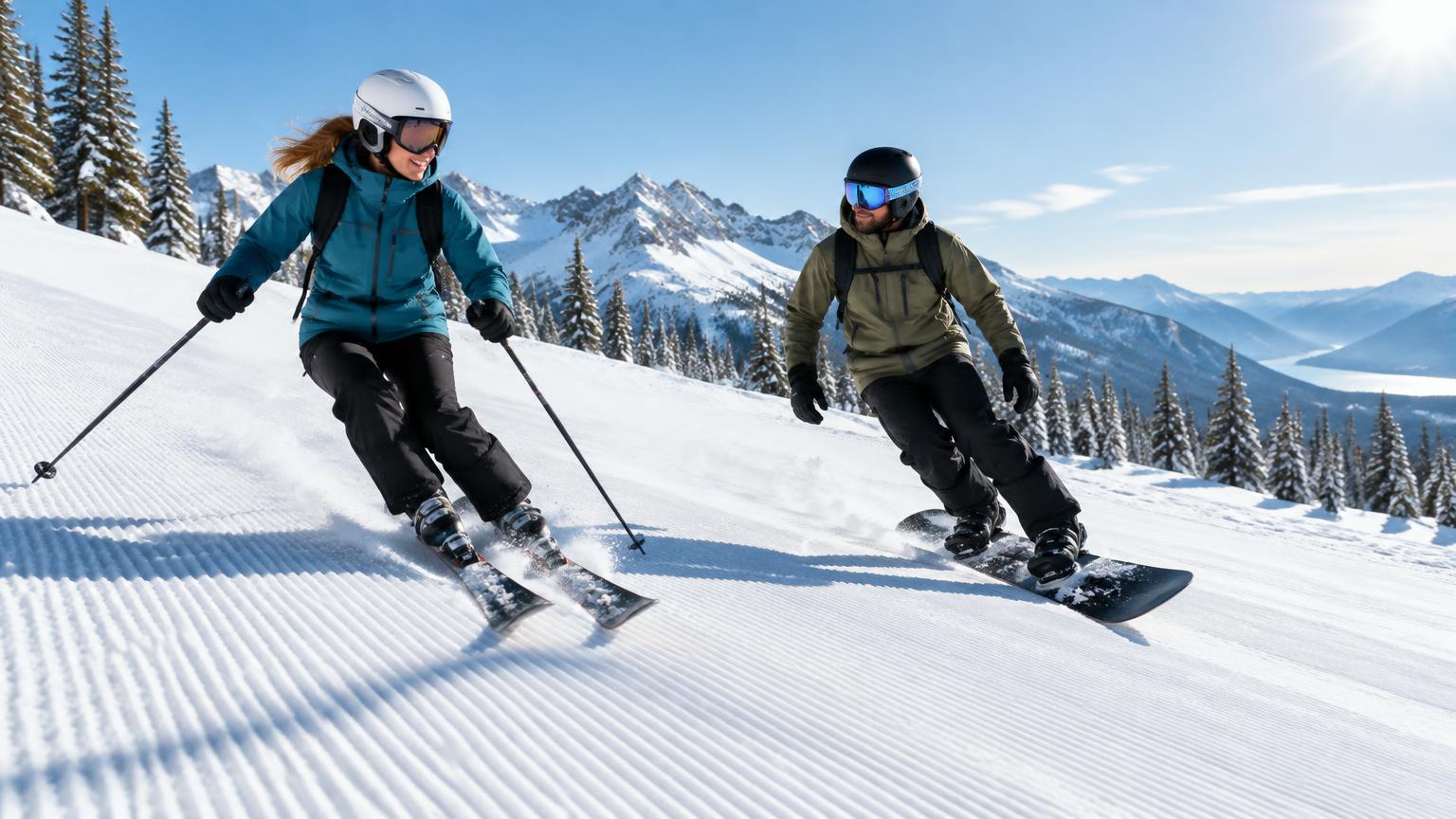
Deciding between learning to ski or learning to snowboard usually comes down to word-of-mouth opinions. This page instead compiles what resort ski schools, the official U.S. instructor certifying body (PSIA-AASI), and peer-reviewed orthopedic research actually publish about the two sports — learning curve, beginner package pricing, and injury patterns — with no ratings, rankings, or personal opinions added.
The short version from the sources: neither sport has an official, universally faster learning curve. PSIA-AASI's own guidance says progress is individual, though instructors report that people without prior board-sport experience often find skiing's forward-facing stance more familiar at first, while people with skateboarding or surfing backgrounds often find snowboarding easier. On cost, most resorts that publish combined packages charge the same price whether a beginner rents skis or a snowboard. On injuries, published research consistently shows skiers are more prone to knee and lower-extremity injuries, while snowboarders are more prone to wrist and upper-extremity injuries, and studies report snowboarders — especially beginners — are more likely to be injured overall.
What was checked for each entry: the resort's own beginner package or lesson page, PSIA-AASI's official guidance, and peer-reviewed or industry-association-cited injury studies. Where a price or detail wasn't published on the page reviewed, that is noted as 'Not published' rather than estimated.
Who this guide is for
- First-timers trying to decide whether to book a ski lesson or a snowboard lesson
- Parents comparing published age minimums for kids' ski vs. snowboard lessons
- Anyone budgeting for a first-time lesson, rental and lift-ticket package
- People weighing injury-risk patterns before choosing a discipline
- Adults with a board-sport background (skateboarding, surfing) wondering if that gives them a head start on snow
How we chose
- Used only PSIA-AASI official guidance, resort ski-school pages, an AAOS press release citing a JAAOS review, and peer-reviewed studies (Davidson & Laliotis 1996; Shoulder & Elbow 2025; Knee Surgery, Sports Traumatology, Arthroscopy 2016)
- Reported beginner package pricing exactly as published by each resort, marking unpublished prices as 'Not published'
- Did not average, rank or score the two sports against each other — each entry states only what its source says
- Excluded any price, spec or claim not directly stated in the sources reviewed
Top 10 at a glance
Specifications as published by the manufacturer or the listing we consulted. Scroll sideways on a small screen.
| Pick | Best for | Source | Category | Key detail | Price | Official site |
|---|---|---|---|---|---|---|
| 1. PSIA-AASI Instructor Guidance on Learning Curve | First-timers without any skateboarding or surfing background weighing which sport to try first | Powder / PSIA-AASI interview (Chris Rogers) | Learning curve | Non-board-sport beginners tend to pick up skiing's forward-facing stance faster, per instructor experience | Not applicable — instructional guidance, not a product | Visit |
| 2. Board-Sport Background and Snowboarding | Skateboarders and surfers deciding whether their existing balance skills transfer to snow | Powder / PSIA-AASI interview (Chris Rogers) | Learning curve | Board-sport background makes snowboarding 'exponentially easier to learn,' per instructor experience | Not applicable — instructional guidance, not a product | Visit |
| 3. Beginner Injury Rate Study (Davidson & Laliotis) | People weighing early-learning injury risk before choosing a discipline | Davidson & Laliotis, 1996 (PMC) | Injury patterns | 49% of injured snowboarders were beginners vs. 18% of injured skiers | Not applicable — research study, not a product | Visit |
| 4. Winter Park Resort Learn to Ski and Ride Package | Colorado-based first-timers wanting a single-day trial of either sport at one published price | Winter Park Resort | Beginner package pricing | From $139 half-day; same price for ski or snowboard | From $139, per Winter Park Resort's own site | Visit |
| 5. Pajarito Mountain Beginner Packages | New Mexico-based families comparing a half-day vs. full-day beginner lesson budget | Pajarito Mountain | Beginner package pricing | $120 half-day / $170 full-day; same price for ski or snowboard, ages 6+ | $120 (half-day lesson) or $170 (full-day lesson), per Pajarito Mountain's own site | Visit |
| 6. AAOS Injury Rate and Volume Data | Anyone wanting a headline injury-risk comparison from a national medical association | AAOS (citing 2018 JAAOS review) | Injury patterns | Snowboarders 3x more likely to be injured than skiers; 88,210 ski vs. 61,668 snowboard injuries (2015, CPSC) | Not applicable — research citation, not a product | Visit |
| 7. Knee vs. Wrist Injury Split (Davidson & Laliotis) | People with a prior knee or wrist injury deciding which sport carries a lower risk to that joint | Davidson & Laliotis, 1996 (PMC) | Injury patterns | Skiers: more knee injuries (39% vs. 17%); snowboarders: more wrist injuries (19% vs. 2%) | Not applicable — research study, not a product | Visit |
| 8. 2025 Upper-Extremity Injury Meta-Analysis | People specifically concerned about shoulder, wrist or hand injury risk | Shoulder & Elbow, 2025 meta-analysis (PMC) | Injury patterns | Shoulder most common in skiing (37%); wrist most common in snowboarding (36%) | Not applicable — research study, not a product | Visit |
| 9. National Trauma Data Bank Fracture Study | People who want fracture-specific national ER data rather than single-study injury percentages | Knee Surgery, Sports Traumatology, Arthroscopy, 2016 | Injury patterns | Lower-extremity fractures more common in skiers; wrist fractures more common in snowboarders (2011–2012 U.S. ED data) | Not applicable — research study, not a product | Visit |
| 10. Vail Mountain Age Minimums and Green Run Guarantee | Parents deciding what age to start a child on skis vs. a snowboard | Vail Mountain / Park City Mountain | Age policy & progress benchmark | Vail: ski lessons from age 3, snowboard from age 5; both resorts target a beginner run by lesson 3 | Not published (price not listed on the pages reviewed) | Visit |
The ten picks in detail
PSIA-AASI Instructor Guidance on Learning Curve
PSIA-AASI
We only show official or licensed product photography. None is on file for this one yet — see the maker's page for photos.
Open product pagePSIA-AASI Instructor Guidance on Learning Curve
Skiing's forward-facing stance is described as more familiar to newcomers without board-sport experience, per a PSIA-AASI National Team member
PSIA-AASI National Team member Chris Rogers says beginner progress is 'really dependent on the person,' but notes that in his experience, newcomers without prior board-sport background tend to pick up skiing faster because it uses a forward-facing stance similar to walking, while snowboarding's sideways stance can feel less natural at first.
Why it is on this list: This is the most direct, sourced statement available on which sport tends to feel easier for a beginner and why.
Key features
- Skiing uses independent feet on two skis and a forward-facing, walking-like stance
- Snowboarding fixes both feet to a single board in a sideways stance
- Instructor experience says non-board-sport newcomers often pick up skiing faster
- Pros
- Comes directly from a PSIA-AASI National Team member who instructs in both disciplines
- Explains the mechanical reason (stance orientation) rather than just asserting a winner
- Cons
- Based on one instructor's experience, not a controlled study
- PSIA-AASI's own official page does not publish a formal rule on which sport is objectively faster to learn
Before you buy: PSIA-AASI's official page (thesnowpros.org) does not publish a formal claim that one sport has a shorter learning curve than the other for everyone.
Board-Sport Background and Snowboarding
PSIA-AASI
We only show official or licensed product photography. None is on file for this one yet — see the maker's page for photos.
Open product pageBoard-Sport Background and Snowboarding
Prior board-sport experience is described as making snowboarding 'exponentially easier to learn,' per a PSIA-AASI National Team member
Per the same PSIA-AASI National Team member, people with prior board-sport experience (skateboarding, surfing, rip-sticking) tend to find snowboarding 'exponentially easier to learn' than people without that background.
Why it is on this list: This is the clearest published guidance matching a specific beginner profile (board-sport background) to a sport.
Key features
- Applies to people with skateboarding, surfing or rip-sticking experience
- PSIA-AASI presents this as instructor experience, not a formal certifying-body rule
- Pros
- Gives beginners with a board-sport background a specific, sourced data point favoring snowboarding
- Consistent with the stance-orientation explanation given for skiing
- Cons
- Still anecdotal instructor experience, not a controlled study
- Doesn't quantify 'exponentially easier' with numbers
Before you buy: PSIA-AASI's official page does not formally match beginner profiles to one sport; the determination is presented as individualized.
Beginner Injury Rate Study (Davidson & Laliotis)
Davidson & Laliotis, 1996
We only show official or licensed product photography. None is on file for this one yet — see the maker's page for photos.
Open product pageBeginner Injury Rate Study (Davidson & Laliotis)
49% of injured snowboarders in the sample were beginners, vs. 18% of injured skiers
A peer-reviewed study of snowboarding and alpine skiing injuries found 49% of injured snowboarders in the sample were beginners, compared with 18% of injured skiers — consistent with a steeper initial adjustment period for many snowboarders.
Why it is on this list: This is the specific peer-reviewed figure most directly tied to the beginner learning-curve question.
Key features
- 49% of injured snowboarders were beginners
- 18% of injured skiers were beginners
- Wrist injuries were the most common injury among beginner snowboarders specifically (30% of snowboard injuries in that group)
- Pros
- Peer-reviewed, published in the American Journal of Sports Medicine
- Directly compares beginner injury share across both sports
- Cons
- Published in 1996; equipment and terrain-park design have changed since
- Describes injured-beginner share, not overall injury-rate difference for beginners specifically
Before you buy: This reflects the makeup of an injured sample, not the overall odds of injury for every beginner.
Winter Park Resort Learn to Ski and Ride Package
Winter Park Resort
We only show official or licensed product photography. None is on file for this one yet — see the maker's page for photos.
Open product pageWinter Park Resort Learn to Ski and Ride Package
Ski and snowboard beginner packages are priced identically at Winter Park
Winter Park Resort's Learn to Ski and Ride package starts at $139 for a half-day group lesson, rental (ski or snowboard), a full-day lift ticket, plus 30% off the next two group lessons — the same price regardless of which sport is chosen.
Why it is on this list: Winter Park is one of the clearest published examples of resorts pricing ski and snowboard beginner packages the same.
Key features
- Half-day group lesson
- Rental (ski or snowboard)
- Full-day lift ticket
- 30% off next two group lessons
- Pros
- Published starting price, from $139
- Same price whether a beginner chooses skis or a snowboard
- Includes a full-day lift ticket plus a discount on the next two lessons
- Cons
- 'From $139' suggests the price can be higher depending on options
- Multi-lesson 5-pack pricing ($759 adult, $1,059 kids) is separate and not itemized by sport
Before you buy: The 5-lesson packs ($759 adult, $1,059 kids full-day) are a separate product from this half-day starter package.
Pajarito Mountain Beginner Packages
Pajarito Mountain
We only show official or licensed product photography. None is on file for this one yet — see the maker's page for photos.
Open product pagePajarito Mountain Beginner Packages
Two published price tiers ($120 and $170) both covering ski or snowboard equally
Pajarito Mountain publishes two beginner packages, both covering ski or snowboard equally: $120 for a full-day lift ticket, rentals and a half-day group lesson, or $170 for the full-day version, ages 6+.
Why it is on this list: Pajarito is one of the few resorts reviewed with two distinct, fully published beginner-package price points.
Key features
- Full-day beginner lift ticket included
- Rentals included
- Half-day or full-day group lesson option
- Ages 6 and up
- Pros
- Two clearly published price points, $120 and $170
- Both include a full-day lift ticket and rentals, not just the lesson
- Cons
- No separate ski vs. snowboard price breakdown published
- Minimum age of 6 excludes younger children
Before you buy: Pricing is identical for ski or snowboard; no separate line-item cost difference is published.
AAOS Injury Rate and Volume Data
American Academy of Orthopaedic Surgeons
We only show official or licensed product photography. None is on file for this one yet — see the maker's page for photos.
Open product pageAAOS Injury Rate and Volume Data
Snowboarders were three times more likely than skiers to sustain an injury, per the JAAOS review AAOS cites
The AAOS, citing a 2018 JAAOS review, states snowboarders were three times more likely than skiers to sustain an injury in the data reviewed; the U.S. CPSC estimated 88,210 skiing-related and 61,668 snowboarding-related injuries treated at hospitals, doctors' offices and ERs in 2015.
Why it is on this list: This is the single most-cited overall injury-rate comparison figure in the sources reviewed.
Key features
- Snowboarders: 3x more likely to be injured than skiers, per the cited review
- 2015 CPSC estimate: 88,210 skiing injuries treated nationally
- 2015 CPSC estimate: 61,668 snowboarding injuries treated nationally
- Skiers more likely to sustain lower-extremity/knee injuries from rotational forces
- Pros
- From a national orthopedic surgeon association citing a peer-reviewed review
- Includes both a relative injury-rate figure and absolute national injury counts
- Cons
- The 2015 CPSC injury counts reflect total participation volume as well as per-person risk, and don't separate the two factors
- The underlying JAAOS review's full methodology isn't detailed on the AAOS press page
Before you buy: These are cited national aggregate figures, not a controlled study Guidevio conducted or verified independently.
Knee vs. Wrist Injury Split (Davidson & Laliotis)
American Journal of Sports Medicine
We only show official or licensed product photography. None is on file for this one yet — see the maker's page for photos.
Open product pageKnee vs. Wrist Injury Split (Davidson & Laliotis)
Skiers: 39% knee injuries vs. snowboarders' 17%; snowboarders: 19% wrist injuries vs. skiers' 2%
Davidson & Laliotis found snowboarders were more likely to suffer wrist injuries (19% vs. 2% for skiers) and ankle injuries (16% vs. 6%), while skiers were more likely to sustain knee injuries (39% vs. 17%) and thumb injuries (4% vs. 2%).
Why it is on this list: This gives the clearest sourced breakdown of which body part is more commonly injured in each sport.
Key features
- Knee injuries: 39% of skier injuries vs. 17% of snowboarder injuries
- Wrist injuries: 19% of snowboarder injuries vs. 2% of skier injuries
- Ankle injuries: 16% of snowboarder injuries vs. 6% of skier injuries
- Thumb injuries: 4% of skier injuries vs. 2% of snowboarder injuries
- Pros
- Directly quantifies which body part is more at risk in each sport
- Peer-reviewed and specifically comparative between the two disciplines
- Cons
- 1996 study; gear like wrist guards has since become more common in snowboarding
- Percentages are of injuries within each sport's sample, not population-wide odds
Before you buy: Figures come from one 1996 four-year study sample, not a universal national rate.
2025 Upper-Extremity Injury Meta-Analysis
Shoulder & Elbow (2025 meta-analysis)
We only show official or licensed product photography. None is on file for this one yet — see the maker's page for photos.
Open product page2025 Upper-Extremity Injury Meta-Analysis
Shoulder injuries dominate skiing's upper-extremity injuries (37%); wrist injuries dominate snowboarding's (36%)
A 2025 meta-analysis covering more than 750,000 upper-extremity injuries found the shoulder was the most commonly injured upper-extremity segment for skiing (37% of upper-extremity injuries) and the wrist for snowboarding (36%); hand injuries were significantly more prevalent in skiing.
Why it is on this list: This is the largest and most recent dataset in the sources reviewed specifically on upper-extremity injury type.
Key features
- 750,000+ upper-extremity injuries analyzed
- Shoulder = 37% of skiing upper-extremity injuries
- Wrist = 36% of snowboarding upper-extremity injuries
- Hand injuries significantly more prevalent in skiing than snowboarding
- Pros
- Very large dataset (750,000+ injuries) compared with older single-site studies
- Published in 2025, more recent than the other cited injury research
- Cons
- Limited to upper-extremity injuries only, not a full-body injury comparison
- Does not by itself state overall injury-rate differences between the sports
Before you buy: Covers upper-extremity injuries only; does not address lower-extremity injury rates.
National Trauma Data Bank Fracture Study
Knee Surgery, Sports Traumatology, Arthroscopy (2016)
We only show official or licensed product photography. None is on file for this one yet — see the maker's page for photos.
Open product pageNational Trauma Data Bank Fracture Study
Distal radius (wrist) fractures were more common in snowboarders; lower-extremity fractures more common in skiers, per national ED data
A National Trauma Data Bank study of 2011–2012 U.S. emergency department data found lower-extremity fractures were the most common injury overall and occurred more often in skiers, while upper-extremity fractures — particularly distal radius (wrist) fractures — were more common in snowboarders.
Why it is on this list: This is the only source among those reviewed based on a national trauma database rather than a single study population.
Key features
- Data source: National Trauma Data Bank, 2011–2012 U.S. ED visits
- Lower-extremity fractures were the most common injury overall
- Lower-extremity fractures occurred more often in skiers
- Distal radius (wrist) fractures were more common in snowboarders
- Pros
- Based on a national trauma database rather than a single resort or clinic
- Confirms the skier-lower-body / snowboarder-upper-body fracture pattern with fracture-specific ER data
- Cons
- Data is from 2011–2012, not current-season figures
- Covers fractures specifically, not all injury types (sprains, contusions, etc.)
Before you buy: Reflects 2011–2012 U.S. emergency department data; more recent national fracture data was not part of the sources reviewed.
Vail Mountain Age Minimums and Green Run Guarantee
Vail Mountain / Park City Mountain
We only show official or licensed product photography. None is on file for this one yet — see the maker's page for photos.
Open product pageVail Mountain Age Minimums and Green Run Guarantee
Vail's minimum age for child snowboard lessons (5) is two years older than for child ski lessons (3)
Vail's child ski lessons are offered from ages 3–15, while child snowboard lessons begin at age 5; both Vail and Park City structure First Timer lessons around a stated 'Green Run Guarantee' — reaching a qualifying beginner run by the third lesson, for either sport.
Why it is on this list: This is the clearest published structural difference between the sports for families, independent of injury or cost data.
Key features
- Vail child ski lessons: ages 3–15
- Vail child snowboard lessons: ages 5–15
- Green Run Guarantee: goal of a qualifying beginner run by the third lesson, ski or snowboard, at Vail and Park City
- Jiminy Peak's shared first-timer package is offered ages 6+ regardless of sport
- Pros
- Gives a concrete, published age-minimum difference between the two sports for kids
- 'Green Run Guarantee' is a stated, resort-published progress benchmark applicable to both sports
- Cons
- Exact adult first-timer lesson pricing was not published on the Vail or Park City pages reviewed
- Age minimums are specific to Vail and may differ at other resorts
Before you buy: Adult first-timer lesson pricing at Vail and Park City was not published on the pages reviewed; a third-party summary estimates roughly $240 for Vail's 3-for-2 series but should be verified directly with the resort.
How the top picks actually differ
Learning curve: what instructors actually say
PSIA-AASI's official position is that learning speed is individual and depends on the person, not a fixed rule favoring one sport. That said, a PSIA-AASI National Team member who instructs in both disciplines reports that newcomers without prior board-sport experience (skateboarding, surfing) tend to pick up skiing faster, since it uses a forward-facing stance closer to walking or running, with each foot moving independently on its own ski. People who do have a board-sport background, by contrast, often find snowboarding's sideways stance 'exponentially easier' to adapt to. A peer-reviewed 1996 study found that 49% of injured snowboarders in its sample were beginners versus 18% of injured skiers, which is consistent with — though not direct proof of — a steeper early adjustment period for many snowboarders.
Cost: beginner packages are usually priced the same
At every resort reviewed that publishes a combined ski/snowboard beginner package — Winter Park, Pajarito Mountain, Jiminy Peak, Pats Peak, Vail and Park City — the listed price does not change based on whether a guest chooses skis or a snowboard. Winter Park's half-day package starts at $139; Pajarito's runs $120 (half-day lesson) or $170 (full-day lesson); Pats Peak's four-day Passport Program is $669 and includes free season-ending gear for adults who complete it. Several resorts (Jiminy Peak, Vail, Park City) don't publish an exact price for their first-timer packages on the pages reviewed. No source in this research breaks out a cost difference between owning ski equipment (skis, bindings, boots, poles) versus snowboard equipment (board, bindings, boots) beyond rental.
Injury patterns: different body parts, different overall risk
Multiple independent sources point the same direction: skiers are more prone to lower-extremity injuries, especially knees, from rotational forces during falls, while snowboarders are more prone to upper-extremity injuries, especially wrists, since a common reflex is to break a fall with an outstretched hand. The AAOS, citing a 2018 review, states snowboarders were three times more likely than skiers to be injured overall in the data it cites, and CPSC estimated more total skiing injuries nationally in 2015 (88,210) than snowboarding injuries (61,668) — a reflection of injury rate and participation volume combined. A 2025 meta-analysis of over 750,000 upper-extremity injuries confirms the same split: shoulder injuries dominate for skiers, wrist injuries dominate for snowboarders.
Physical setup: what each sport actually asks of your body
Skiing keeps the feet independent on two skis, which lets a skier react to each leg separately but also introduces rotational knee stress during falls. Snowboarding fixes both feet to one board, which changes the fall mechanics and balance demands, and is why snowboard first-timer programs (e.g., Jiminy Peak's) include wrist guards as standard equipment. Resort ski-school curricula for beginners cover similar foundational skills for both — putting equipment on and off, controlling body position, turning, stopping, and loading/unloading a chairlift — but taught from a forward-facing stance for skiing versus a sideways stance for snowboarding.
Who should choose what
You have no prior skateboarding or surfing experience
Per PSIA-AASI instructor guidance, you may find skiing's forward-facing, independent-leg stance more familiar at first
You have a skateboarding or surfing background
Per the same guidance, that background may make snowboarding 'exponentially easier to learn'
You have a history of knee injuries
Published injury research shows skiers are more prone to knee injuries from rotational falls; discuss the risk with a doctor before choosing
You have a history of wrist injuries
Published injury research shows snowboarders are more prone to wrist injuries, especially as beginners; wrist guards are standard equipment in some first-timer snowboard programs
You're budgeting a first lesson
Check the resort's own package page — most resorts reviewed charge the same price for a ski or snowboard beginner package
You're enrolling a young child
Check age minimums directly with the resort — Vail, for example, allows ski lessons from age 3 but snowboard lessons only from age 5
Common questions
- Is skiing or snowboarding easier to learn?
- There's no official rule either way. PSIA-AASI says learning speed is individual, but instructor experience suggests people without board-sport backgrounds often find skiing's forward-facing stance more familiar at first, while people with skateboarding or surfing experience often find snowboarding easier.
- Do ski and snowboard lessons cost different amounts?
- At the resorts reviewed that publish combined packages (Winter Park, Pajarito, Jiminy Peak, Pats Peak, Vail, Park City), the listed price for a beginner lesson package is the same whether you choose skis or a snowboard.
- Which sport has a higher risk of injury?
- Per an AAOS press release citing a 2018 review, snowboarders were three times more likely than skiers to be injured in the data reviewed, and beginners made up a larger share of injured snowboarders (49%) than injured skiers (18%) in a separate 1996 study.
- What body parts are most at risk in each sport?
- Published research consistently shows skiers are more prone to knee and lower-extremity injuries from rotational falls, while snowboarders are more prone to wrist and other upper-extremity injuries, often from breaking a fall with an outstretched hand.
- What age can kids start ski or snowboard lessons?
- This varies by resort. At Vail, child ski lessons are offered from ages 3–15, while child snowboard lessons begin at age 5. At Jiminy Peak, the shared first-timer package is offered from age 6 for either sport. Check age policies directly with the resort you plan to visit.
- How many lessons does it typically take to reach a beginner run?
- Vail and Park City both structure their First Timer lesson series around a stated 'Green Run Guarantee' — the goal of skiing or snowboarding down a qualifying green (beginner) run by the third lesson, for either discipline.
Related guides
When Does Ski Season Start? Regional Windows and 2026/27 Opening Dates
A region-by-region look at typical ski-season opening and closing windows, plus the specific 2026/27 opening dates that resorts and operators have officially published so far.
How Much Does a Ski Trip Cost? Lift Tickets, Rentals, Lessons, and Lodging
Ten real cost line items — lift tickets, season passes, rentals, lessons and lodging — pulled directly from resorts' and rental shops' own official pages, to show what a ski trip actually costs.
Best All-Mountain Skis for 2026
Ten current-production all-mountain skis compared on waist width, rocker profile, sizing and published pricing, spanning approachable frontside carvers to wider freeride-leaning models.
What to Wear Skiing: The Layering System, Materials, and Accessories
The 10 concrete items of a ski outfit — base, mid and outer layers, socks, gloves, headwear, eyewear and a helmet — drawn from REI, NSAA, Vail Resorts and CDC guidance, with what to skip and why.
Best Snowboard Bindings of 2026: Top 10 Picks
Ten currently sold snowboard bindings — from do-it-all all-mountain bindings to strapless step-on and fast-entry systems — compared on published flex, entry type, and price.
Best All-Mountain Snowboards of 2026: Top 10 Boards for Groomers, Powder and Park
This guide compares 10 currently sold all-mountain snowboards for the 2025/26–2026 season by published shape, profile, flex and price, from a stiff camber carver to a playful asym twin, based on verified manufacturer and retailer specs.
One useful email a week
New guides, revisions to existing ones with a note on what changed and why, and price moves worth knowing about. One email a week, unsubscribe anytime.